The Modern Fishing Guide’s Marketing Ecosystem: Turning "Likes" into Deposits

The Modern Fishing Guide’s Marketing Ecosystem: Turning "Likes" into Deposits
The Guide’s Dilemma: Fishing vs. The Hustle
Let’s be honest about the reality of this job. You didn't become a fishing guide because you love managing a CRM, wrestling with WordPress plugins, or staring at Google Analytics dashboards. You did it to be on the water, poling a skiff or rowing a drift boat, hunting for that next fish.
But the romantic version of the job—the one where you just show up at the dock and fish—is a relic of the past. The modern outdoor industry is ruthless. You can be the "fishiest" guide in the county, knowing every tide phase and hatch, but if your calendar is empty, you aren't a professional guide. You’re a hobbyist with an expensive boat payment.
The Death of the "Shop Referral"
For decades, the industry ran on a handshake economy. You got your trips from the local tackle shop, the lodge desk, or word of mouth at the bar. While those relationships still matter, they are no longer enough to build a scalable, six-figure business.
The modern angler shops with their eyes first. They don't call the fly shop to ask "Who's good?" anymore. They open Instagram. They search Google Maps. They look for video proof. By the time they actually contact you, they have already vetted your boat, your gear, your personality, and your results.
If you are invisible on these digital channels, you aren't just missing out on growth; you are losing market share to the new generation of guides who understand that they are running a media company that happens to sell fishing trips.
Building an Ecosystem, Not Just a Website
If you want to stop chasing last-minute bookings and start cherry-picking your ideal clients, you need more than a few "grip-and-grin" photos. You need a Marketing Ecosystem.
An ecosystem is different from a strategy. A strategy is "I’m going to post on Facebook." An ecosystem is a set of interconnected assets—Social, Web, Search, and Email—that work together to capture leads, build trust, and drive revenue while you are out on the water.
Here is the exact 5-pillar system we build for top-tier outfitters to turn digital noise into paid deposits.
Pillar 1: Social Media (The Engine of Discovery)
In the outdoor world, social media isn't just "content." It is your daily brochure. It is the single most powerful tool for generating desire. But most guides get it wrong. They treat Instagram like a photo album for their buddies rather than a sales funnel for prospective clients.
To make social media pay the bills, you need to shift your mindset from "Validation" (getting likes) to "Conversion" (getting inquiries).
1. Sell the Moment, Not Just the Meat
The biggest mistake guides make is posting nothing but "Dead fish on a dock" or "Angler holding fish." While proof of catch is important, it becomes repetitive white noise.
High-value clients—the ones who tip well and rebook next year—are buying an experience, not a carcass. They want to see:
- The Anticipation: A bent rod at sunrise with the water spraying off the line.
- The Environment: A drone shot of the skiff poling a glass-calm flat or a drift boat navigating a rapid.
- The Emotion: The high-five after the release, or the exhausted smile after a 30-minute fight.
Actionable Tip: Audit your last 9 posts. If more than 6 of them are just a client holding a fish, you need to diversify. Add a shot of the coffee on the cooler, the fly box, or the landscape. Make the viewer feel like they are in the boat.
2. Consistency is Your "Open" Sign
You cannot post once a month and expect results. In the client’s mind, if you aren't posting, you aren't fishing. And if you aren't fishing, you must not be very good.
Regular updates prove that you are "dialed in." When a potential client sees a Story from you this morning showing clear water and happy clients, it creates urgency. It tells them, "The bite is on, and I'm missing it."
The "Stories vs. Feed" Strategy:
- The Feed (Your Resume): Keep your main profile grid curated. High-quality photos, professional editing, timeless shots. This is your portfolio.
- Stories (Your Reality): This is where you can be raw. Post the weather report, the busted knuckle, the quick video of the release. Stories build the personal connection that leads to the DM asking, "You have days in October?"
3. The "Vibe Check": Why They Pick You
There are likely 50 other guides in your area targeting the exact same fish. Why should a client pick you?
It usually comes down to personality. Clients are about to trap themselves on a 16-foot boat with you for 8 hours. They are terrified of getting stuck with the "grumpy guide" who yells at them for missing a cast.
Use video to show your temperament. Show yourself teaching a kid to cast. Show yourself laughing off a missed fish. Demonstrate patience and professionalism. When a client sees you are a good human, the price tag becomes irrelevant.
4. Technical Discovery: Geotags and Hashtags
You might be posting gold, but if nobody sees it, it doesn't matter. You need to signal to the algorithms where you are.
- Geotags: Always tag your specific location (e.g., "Mosquito Lagoon" or "South Holston River"), not just "Florida" or "Tennessee." Anglers search by specific bodies of water.
- The "Link in Bio" Strategy: Don't let that traffic hit a dead end. Your bio shouldn't just say "Capt. John Doe." It needs a direct Call to Action. Change it seasonally: "Now Booking 2026 Tarpon Season – Click to Check Dates."
Pillar 2: The Website (The Closer)
Social media gets them excited. Your website gets them to commit.
This is the failure point for 80% of guide businesses. You hustle on Instagram, you post great content, and you drive traffic to your bio link. But then, the user lands on a slow, clunky website built on a DIY template from 2016. They get frustrated, they hit the "Back" button, and they go to the next guide on the list.
Your website is not a digital brochure. It is a 24/7 Salesperson. It needs to overcome objections, build trust, and ask for the sale—all while you are out on the water.
1. Mobile-First is Non-Negotiable
Here is a stat that should scare you: Over 70% of fishing charters are researched on a smartphone.
If your website requires a user to "pinch and zoom" to read your pricing, or if your menu is impossible to click with a thumb, you are bleeding money. Google also indexes websites based on their mobile version. If your mobile site is slow, your Google ranking tanks.
The "Thumb Zone" Test: Open your website on your phone right now. Can you reach the "Book Now" or "Call Me" button with your thumb while holding the phone in one hand? If not, you are creating friction. The path to paying you should be the easiest road on the map.
2. Answer the "Big 3" Immediately
When a potential client lands on your site, they are looking for three specific pieces of information. If they can’t find them in 10 seconds, they bounce.
- What do you fish for? (Species & Method: "Fly Fishing for Tarpon" vs. "Light Tackle for Redfish").
- Where do you launch? (Geography: Don't just say "Keys." Say "Picking up at the Lorelei in Islamorada").
- How much does it cost?
The Pricing Debate: Many guides hide their prices, thinking, "I want them to call me so I can sell them on the value." Stop doing this.In the digital age, hidden pricing looks suspicious. It suggests you are too expensive or making it up as you go. publishing your rates filters out the "tire kickers" who can't afford you, ensuring that when the phone does ring, it’s a qualified lead ready to book.
3. Frictionless Booking: The Inquiry Form
Stop using generic "Contact Us" pages. A form that just asks for "Name, Email, and Message" is lazy. It forces the client to write a paragraph explaining what they want, and it forces you to email back asking for dates.
Replace your Contact page with a Trip Inquiry Engine:
- Field 1: Desired Dates (Date Picker)
- Field 2: Number of Anglers (1 or 2?)
- Field 3: Skill Level (Novice or Expert?)
- Field 4: Type of Trip (Half Day or Full Day?)
This does two things: It makes the client feel like they are starting a reservation (psychological buy-in), and it gives you all the data you need to say "Yes" or "No" in a single reply.
Pro Tip: If you are running high volume, stop using email forms entirely and integrate a booking engine like FareHarbor, Peek Pro, or Origin. These allow clients to see live availability, swipe their credit card, and pay a deposit instantly at 11:00 PM while you are asleep.
[INTERNAL LINK: View our Portfolio of High-Converting Lodge & Guide Websites]
Pillar 3: Local SEO (The Safety Net)
Social media captures the people who are browsing (dreaming about a trip). Local SEO captures the people who are hunting (ready to buy a trip).
Imagine a family on vacation in your town. The dad wakes up early, grabs his coffee, and types into Google: "Fishing guide near me" or "Best fly fishing charter [Your City]."
At this moment, your Instagram following of 20k people means absolutely nothing. The only thing that matters is the Google Map Pack (the map listing that appears at the top of the search results). If you aren't in the top 3 spots, you are invisible.
1. The Google Business Profile (Your Digital Real Estate)
This is your most valuable asset outside of your boat. It is free, but most guides ignore it or leave it half-finished.
- Claim and Verify: Ensure you own the listing.
- The "NAP" Rule: Your Name, Address, and Phone number must be identical across the web. If your website says "Capt. Dave" but Google says "David's Fishing," Google gets confused and ranks you lower.
- Photos: Upload photos of your boat, your captain’s license, your gear, and happy clients directly to your Google profile. Google favors profiles that are active.
2. Reviews: The Currency of Trust
In the service industry, trust is the barrier to entry. A client is paying a stranger $600+ to take them out on the ocean. They are looking for reassurance.
A 5-star rating on Google validates everything you claimed on your website. It is "Social Proof."
The Automation Strategy:Don't hope they review you; systematize it.
- Step 1: As the trip ends and you are shaking hands, say: "I had a blast guys. If you had a good time, a review on Google really helps my small business."
- Step 2: Send a text message (not email) 2 hours later with a direct link to the review form. "Hey guys, great fishing today. Here is that link if you have a second: [Link]. Thanks, Capt. Jack."
3. Targeting "Near Me" Intent
To win Local SEO, you need to prove to Google that you are a local authority.
- Local Content: Stop writing generic blogs like "How to cast a fly rod." There are a million of those. Write content specific to your geography: "The Ultimate Guide to Spring Tarpon in [Your City]" or "What to Expect Fishing the [Specific River] in October."
- Location Pages: If you pick up clients at three different boat ramps or marinas, create a dedicated landing page on your website for each location. This helps you rank when someone searches "Fishing guide [Marina Name]."
Pillar 4: Google Ads (The Faucet)
Organic SEO (Pillar 3) builds wealth over time. Google Ads generates cash right now.
We call this pillar "The Faucet" because it gives you total control. The biggest problem with guiding is seasonality. You are slammed in May, but starving in October. With Google Ads, you turn the faucet on when you have holes in the calendar, and you shut it off the second you are booked.
1. Capturing "High Intent" (The Credit Card User)
There is a massive psychological difference between someone scrolling Instagram and someone searching Google.
- Social User: Is bored, looking at fish pictures. Might book a trip someday.
- Search User: Types "Book Tarpon Guide Key West Price." This person has their credit card in their hand. They are looking for a place to put their money today.
You aren't paying for "brand awareness." You are paying to jump the line and put your offer in front of the person who is actively trying to buy what you sell.
2. The "Negative Keyword" Secret
This is where 90% of guides lose their shirts. They try to run their own ads, they set up a "Smart Campaign," and they bid on the word "Fishing."Google then takes their money and shows their ad to people searching for:
- "Fishing knots"
- "Fishing license cost"
- "Tide charts"
- "Bass Pro Shops near me"
These people are not looking for a $600 charter. They are looking for free information. You pay for the click, they leave immediately, and you burn your budget.
The Pro Strategy: The secret to high-ROI ads isn't just what you bid on; it's what you exclude. We build massive "Negative Keyword Lists" that tell Google: "Do not show this ad if the search includes words like: license, knots, video, how to, cheap, or employment." This ensures every dollar spent goes toward a qualified lead.
3. The Math of the ROI
Many guides are scared of "Paying for Clicks." But let’s look at the math.If an average click costs $2.00, and your website converts 5% of visitors into inquiries, you need 20 clicks to get one solid lead. That costs you $40.If that lead books a trip for $600 (plus tip), would you trade $40 for $600? Every single day.
When dialed in, Google Ads is not an expense. It is a vending machine: Put $1 in, get $10 out.
[INTERNAL LINK: See our Paid Search & PPC Management Services]
Pillar 5: Email Marketing (The Annuity)
The most profitable client you have is the one you don't have to market to.
It costs roughly 10x more to acquire a new angler (via Ads or SEO) than it does to re-book an old one. Yet, most guides let their past clients walk away, shake hands, and never speak to them again unless the client reaches out.
1. Own Your Audience
We have seen it happen: A guide builds a massive business on Facebook, the algorithm changes, and suddenly their posts reach nobody.You do not own your social media following; you are renting it from Zuckerberg.You own your email list. It is the only asset that no algorithm can take away from you. Every liability waiver signed should automatically add that client's email to your database.
2. The "Season Opener" Strategy (No Newsletters Required)
You are a fishing guide, not a blogger. You do not need to send a "Weekly Newsletter" with updates on your dog or the weather. You just need to be strategic.
We recommend the "First Dibs" Protocol:
- 90 Days Before Season Opens: Send one text-based email to your past client list.
- The Script: "Hey everyone, 2026 Tarpon dates are officially open. I am giving past clients 48 hours to book their preferred tides before I post availability to Instagram and the public. Reply to grab a spot."
This creates scarcity and loyalty. You will often fill 80% of your prime dates in 24 hours without spending a dime on marketing.
3. The "Cancellation Fill"
A last-minute cancellation used to mean lost income. With an email list, it’s an opportunity.Send a blast: "Had a cancellation for this Friday. Tide looks great for Redfish. First one to reply gets the day at a $50 discount."You turn a $0 day back into a profitable day in ten minutes.
Build Your System
You can try to glue these pieces together yourself using generic tools, chasing the latest Instagram trend, and hoping the phone rings. Or, you can build a purpose-built system designed for the specific economics of the outdoor industry.
At Flood Tide Digital, we understand the flow of the angler—because we are anglers. We don't just build pretty websites; we build the engine that drives them. We handle the SEO foundation, the ad strategy, and the conversion flow so you can focus on what you actually get paid to do: Find the fish.
Related posts
Enjoy some of our latest posts. Go ahead, dig in.
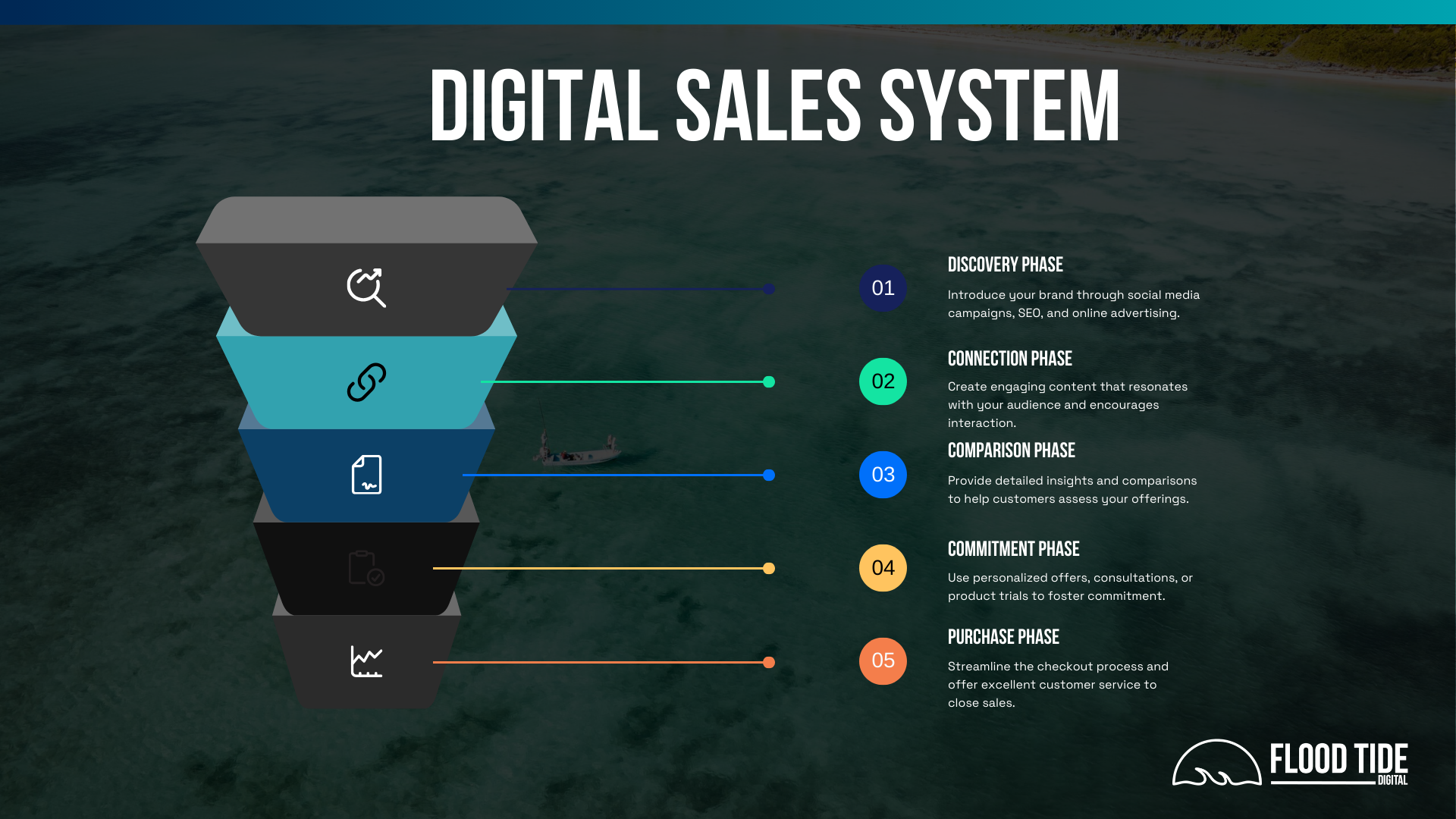
A Website Is Not a Sales System (Here’s What Outdoor Businesses Are Missing)

The Modern Fishing Guide’s Marketing Ecosystem: Turning "Likes" into Deposits
How Outdoor Lodges Can Grow Bookings With Better Web Design and SEO