
A boat is the most researched purchase most of your buyers will make outside of a house. By the time someone calls your shop or walks up to your booth at a show, they’ve usually spent weeks on your website, your competitors’ websites, forums and YouTube. Most of the decision gets made on your site before you ever talk to them.
I restore and run my own skiff, and I’ve built sites for skiff, bay boat, sport fishing and drift boat builders. The builder sites that sell aren’t the ones with the flashiest homepage. They’re the ones that give a serious buyer everything they need to justify the purchase, then make the next step easy.
Build the site around the boats, not the company
Most builder sites lead with the company story: the founder, the history, the shop. That matters, but it’s not what the buyer came for. They came to figure out which hull fits how they fish and whether it’s worth the money.
Lead with the lineup. A buyer should see every model, what each one is for, and how they compare, in one scroll. Let the heritage back up the boats instead of burying them.
Model pages do the heavy lifting
Every model needs its own page, and that page has to make the full case for the boat:
- What it’s built for. Where it runs, what it fishes, who it’s for. “Poles in 8 inches, runs offshore on a calm day” tells a buyer more than three paragraphs of adjectives.
- Real specs. Length, beam, draft, dry weight, deadrise, fuel capacity, max horsepower, people capacity. Lay them out so they’re easy to compare across your models and against other builders. Serious buyers will compare anyway, so let them do it on your site.
- Layout and options. Standard features, upgrades, and how each choice changes the boat.
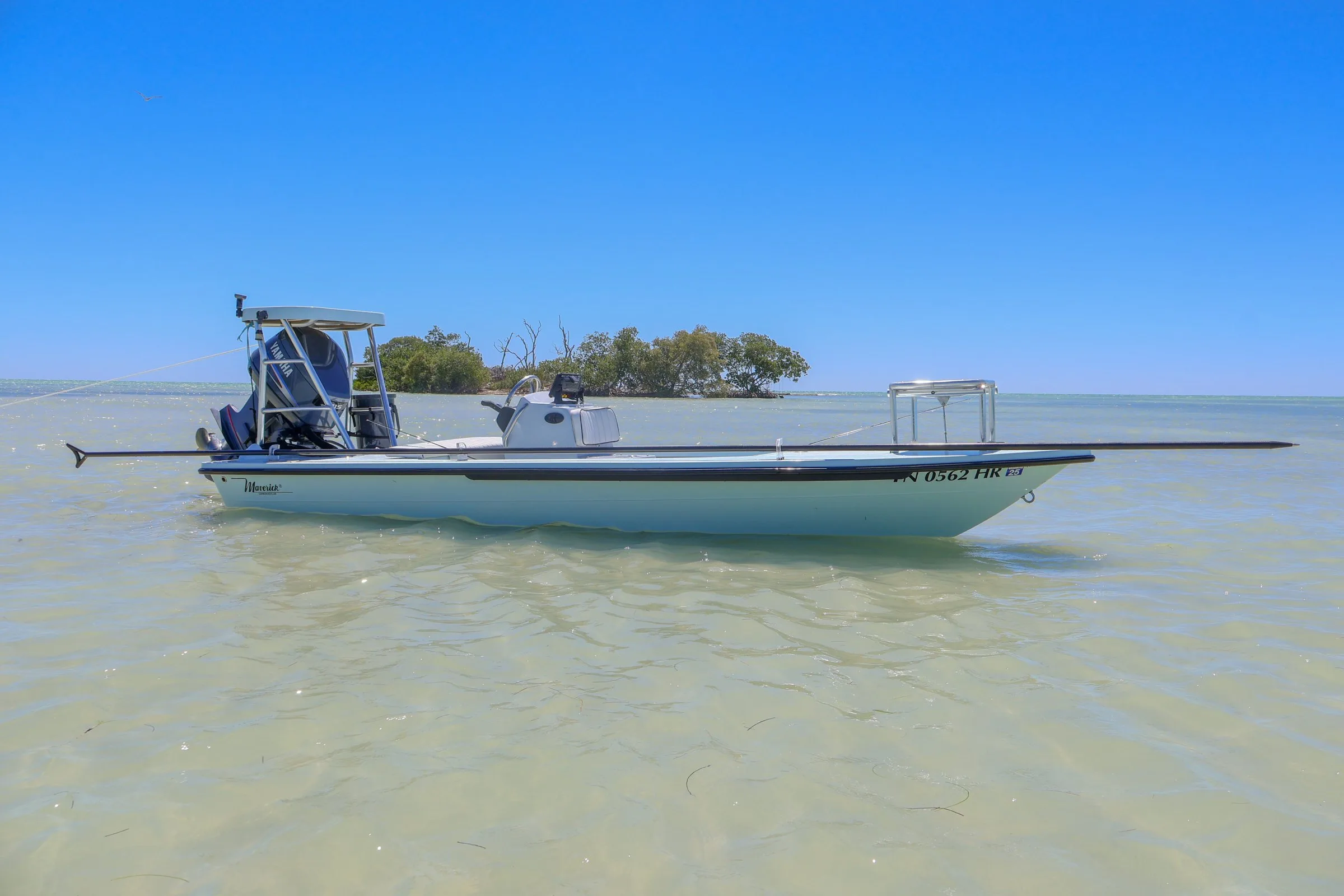
- Real photography and video. On the water, running and fishing, with people aboard. Show the bow entry, the deck layout, the console and the rigging, because those are the angles buyers ask about.
- One clear next step. Request a quote, book a sea trial or build your boat, on every model page.
On Islamorada Boatworks the whole site is organized around the lineup, from the poling skiff to the inshore offshore crossover, and each model gets room to make its case with clear paths to a sea trial or quote. It brought in 154 leads in its first 5 months. Stuart Boatworks uses model by model breakdowns built for buyers who are comparing builders.
Give a pricing signal
Builders hate publishing prices, and for semi custom and custom boats a single number doesn’t make sense. But a buyer with no idea of the range will either assume you’re out of reach or spend your time on a call that was never going to close.
You don’t need a full price list. A “starting at” price per model, or a typical range for a common build, qualifies the lead before it reaches you. The people who leave over it were never going to buy. The ones who stay are serious.
A build path turns interest into a real conversation
A build your boat form is one of the best lead tools a builder can have. It lets someone spend real time with the boat, pick hull color, power and options, and send you a configuration you can actually quote. That’s a much warmer lead than “contact us.”
It doesn’t need to be a 3D configurator. A well designed form that walks through the real choices does most of the job. RO Drift Boats uses a build your boat path that turns interest into a real configuration, and the site brought in 264 leads in its first 9 months.
Launching a new model
A new hull needs its own launch page before it’s even in the water: what makes it different, the specs, renderings or first photos, and a way to get on the list. When Catch Boatworks brought its 27 foot crossover to market, we built the site around the boat itself, with the hull’s capability up front and every spec and next step easy to reach. It brought in 437 leads in its first 7 months.
Dealers, factory sales or both
Be clear about how someone actually buys. If you sell through dealers, a dealer locator that works on a phone is essential, and every model page should route people to the nearest dealer. If you sell factory direct, make the quote and sea trial path obvious. If you do both, decide early who gets each lead (you, the dealer or both) and tell the buyer what happens next.
Leads have to go somewhere
A serious boat lead that sits in an inbox for three days probably went to the builder who answered first. Every quote request, build submission and sea trial request should land in one place, send the buyer an instant confirmation and notify whoever owns the sale. Keep track of where your leads come from, even if that just means asking every buyer how they found you.
On Catch Boatworks we built the CRM behind the site so every inquiry lands somewhere it gets followed up. On any build, that’s our inquiry and follow-up automation add-on for $1,500: CRM setup, form routing and follow up sequences built around how you sell.
Speed and mobile still matter
Builder sites are heavy: video heroes, big galleries, high resolution photos. If that isn’t optimized, the site crawls on a phone, and plenty of your buyers browse at night on the couch or at the ramp. Compress everything, load video only when it’s needed, and test on a real phone.
Get found for the boats people search for
Buyers search by type and use: “bay boat for skinny water,” “best poling skiff,” “27 foot center console for inshore and offshore,” “drift boat for two anglers.” Model pages that explain what each boat is built for, in specific language, are what show up for those searches. A complete Google Business Profile, your boat show schedule and owner reviews round it out.
What a build looks like
Builds start at $4,000, and the tiers go up from there to $6,000 and $8,000+. Boat builders with deep lineups usually land in the top tier. Additional pages are $250 each. The inquiry and follow-up automation add-on is $1,500. Most builds take about 4 to 6 weeks from kickoff to launch. That’s typical, not a hard rule, and the biggest variable is how fast specs, photos and decisions come back from your side. Every site runs on a required Care Plan at $149 or $300 a month. If you have a model launch or a show coming, tell me the date and we’ll plan backward from it.
The short version
A boat builder’s site should sell boats. Lead with the lineup, publish the specs buyers compare, give a pricing signal, offer a build or quote path, and handle every lead fast. For the bigger idea behind all of this, read why most outdoor websites don’t convert.
You can see the builder sites we’ve done, read more on our boat builder websites page, or send me your lineup.